
HSE Cockpit
Our own software for offshore wind.
Risk assessments, incidents, contractor reports and safety figures for every wind farm — in one system, in German and English. Built by offshore HSE practitioners, in Hamburg.
The core of the cockpit
Incident → Risk Assessment loop
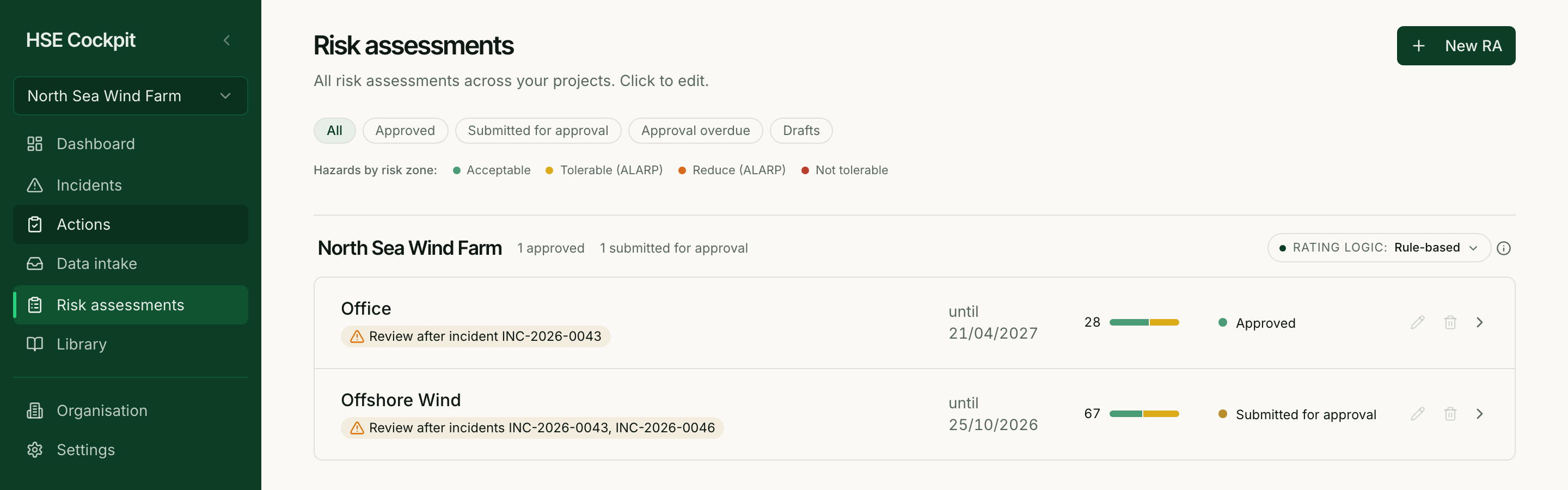
An incident is reported by QR code or in the cockpit, then investigated: the sequence, the causes, the lessons. It is linked to the hazard it exposed, the controls are checked against what actually happened, and the cockpit creates the review action itself — with an owner and a due date. The assessment comes back as a new signed version, and the next incident is measured against that one.
That circle is what usually breaks. The investigation ends in a report, the report ends in a folder, and the assessment stays as it was.
- Incident report via QR or cockpit
- Causes incident investigation
- Hazard linked
- Controls checked action assigned
- RA review due action assigned
- Signed RA version logged
The next incident is measured against the new version
Six problems from offshore practice — and what the cockpit does about them
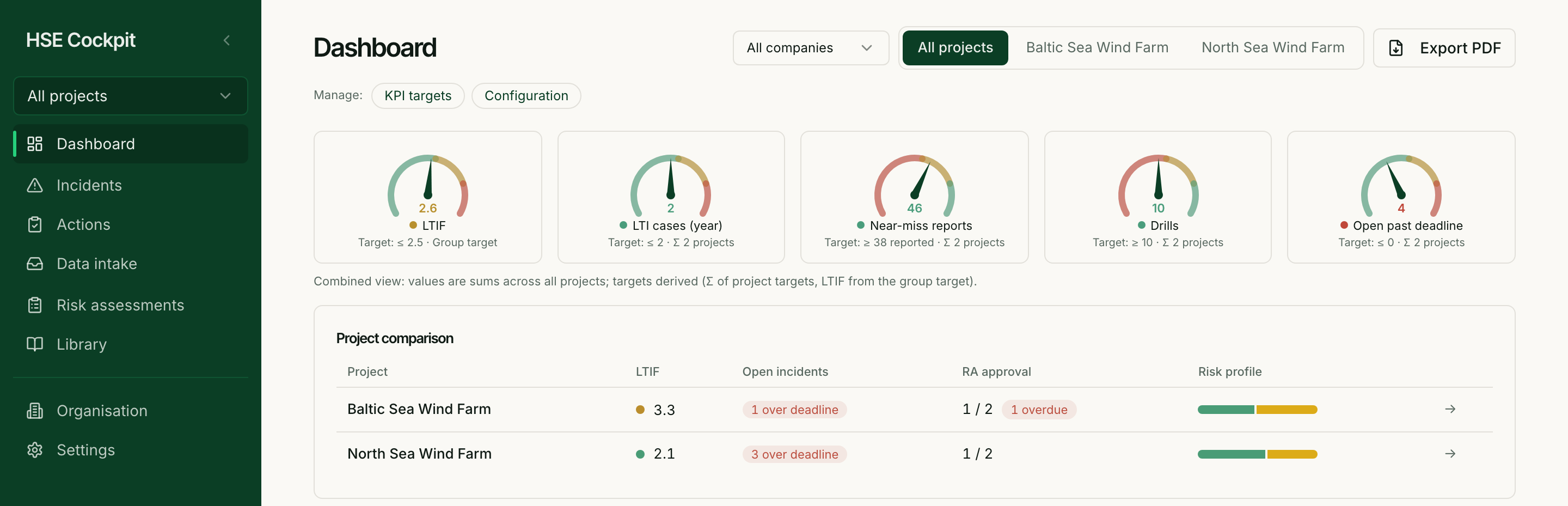
KPI cockpit
The LTIF across all wind farms? Three days of spreadsheet work.
LTIF, near misses, drills and overdue actions against targets — per wind farm or fleet-wide.
QR reporting
Near misses never get reported.
QR code, form on any phone — no login, anonymous if wanted, with a review queue.
Incident investigation
The investigation lives in an email thread.
Guided investigation with the team: sequence, causes, lessons — with owners and a report as PDF.
Data intake
Someone retypes contractor reports every month.
Upload via link without an account, AI proposal, approved by your HSE manager.
Risk assessments
Assessments in Word, and nobody knows which version counts.
Assessments built from one curated offshore library: hazards per work area, ALARP rating, STOP controls — versioned and released.
Actions
Actions get agreed — and nobody checks whether they were done.
Actions are created on incident assignment, risk assessment review and release — each with an owner, a due date and proof of completion.
Demo organisation · fictional data
What the cockpit looks like
What you get out of it
Managing director
Duty of care provable: who released which version when — and the client's figures without a folder hunt.
HSE manager
No Word versions, no retyping: one offshore library, one actions register, every investigation documented.
Head of offshore projects
Contractors report without licences; wind farms and contractor crews compared side by side.
Technician
Reporting in two minutes by QR code; the valid assessment and their own actions on the phone.
Software and HSE consulting from one source
We set up your projects, contractors and library in the cockpit, and we stay available afterwards — with our own offshore HSE experience. The software is one of our six fields of work, and the HSE experience behind it comes with it.